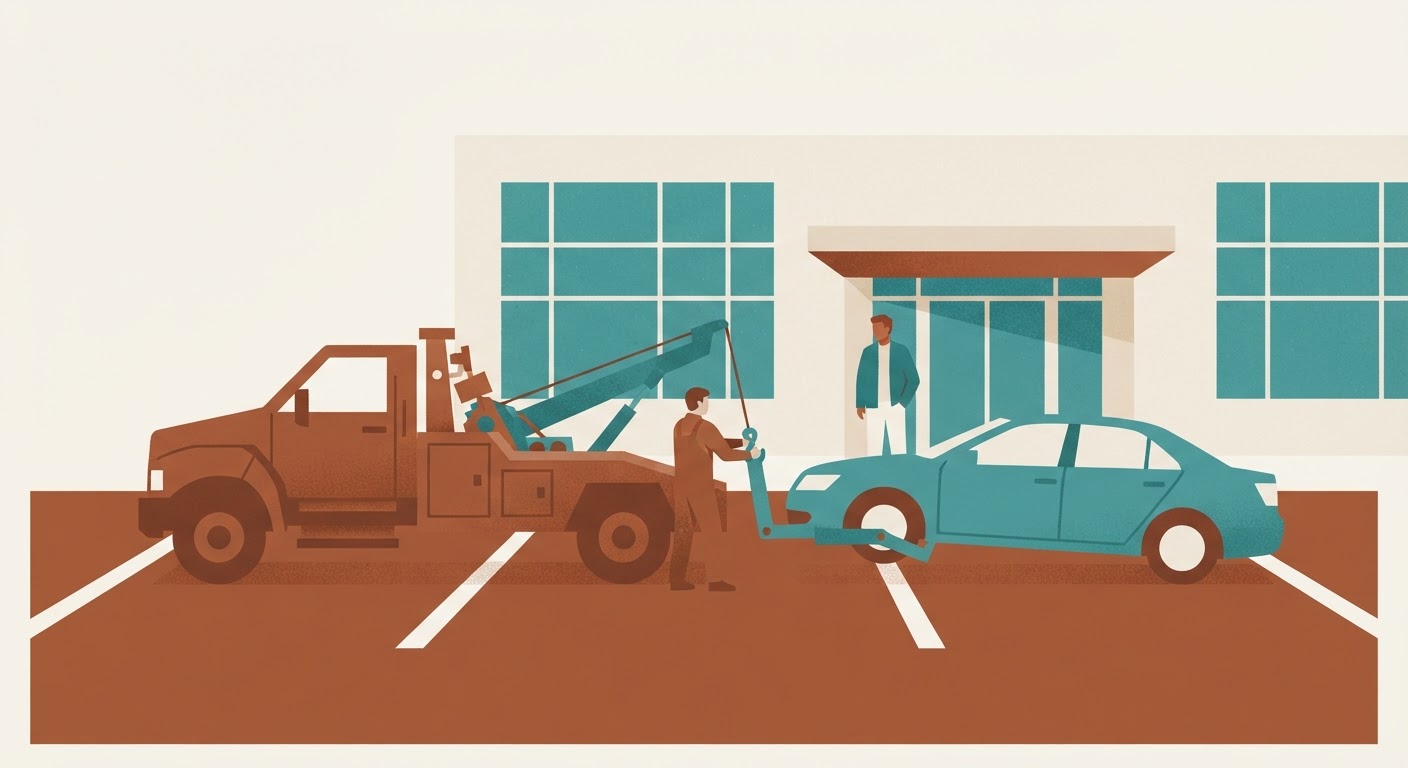
Seeing a tow truck idling near your car in the employee lot is one of the more disorienting moments a financial crisis can produce. You’re at work. Coworkers are watching. And someone you’ve never met is treating your vehicle like it’s already gone. Here’s what’s actually happening, what the agent is and isn’t allowed to do, and how to keep this moment from turning into a second crisis on top of the first.
Why lenders sometimes track vehicles to a workplace instead of a home address
Repossession agents work off whatever address information the lender has on file, and that often includes an employer’s address pulled from your original loan application or a pay stub submitted during underwriting. If your car hasn’t been at your home address during the hours an agent has checked, your workplace becomes the next logical place to look, especially if it has a predictable schedule. This isn’t targeted harassment. It’s usually just the most reliable place to find the vehicle parked in one spot for several hours.
Agents are typically paid per successful repossession, which means they have an incentive to move quickly once they locate the car. That’s part of why this can feel sudden and aggressive, even when the agent is following standard procedure.
What counts as ‘breach of peace’ if the agent enters a private lot or garage
Repossession agents generally have the right to take a vehicle from a public parking area without your consent, but there are limits on how far they can go to get it. Most jurisdictions recognize a concept often called “breach of peace,” which restricts an agent from doing things like forcing open a locked gate, entering a garage without permission, physically confronting you or a bystander, or continuing the repossession after you’ve clearly objected in person.
A workplace lot adds a layer of complexity because it’s private property, not a public street. If the lot is gated, monitored, or requires a badge or code to access, the agent may need permission from the property owner or manager to be there at all. If you see the agent already inside a restricted area, that’s worth documenting, because it may affect whether the repossession was carried out properly. This is also why involving a manager or security guard early, if one is nearby, can sometimes pause the process long enough for you to think clearly.
What breach of peace does not typically cover is the agent simply showing up and hooking up the car while you watch, upset. Discomfort and embarrassment aren’t the same as a legal violation, even though it feels like one in the moment.
Your right to remove personal items before the car is towed, even at work
In most cases, you’re entitled to remove personal belongings from the vehicle before it’s towed away, and a reasonable agent will allow this. Ask calmly and directly: “I need a few minutes to get my things out of the car.” Move with purpose rather than urgency, and grab the essentials first, in case the agent is less patient than you’d hope. Common items people forget in the panic of the moment include:
Work badges or uniforms kept in the trunk, medication in the glove compartment, a phone charger, sunglasses, spare cash, tools you use for your job, and any documents like insurance cards or registration paperwork.
If the agent refuses to let you retrieve items or drives off before you’ve had a reasonable chance, write down the time, the tow company name if visible, and what was left inside. You can request the items back afterward, and having a clear record helps that conversation go faster.
How to talk to your employer or HR before rumors spread
A tow truck in the parking lot draws attention, and coworkers will talk regardless of what you do. The better move is usually to get ahead of it with a short, matter-of-fact explanation to your direct supervisor or HR rather than letting secondhand versions circulate. You don’t owe anyone a detailed financial history. A simple line works: “My car was repossessed today. It’s a personal financial matter I’m handling. I wanted you to hear it from me instead of secondhand.”
This matters for practical reasons beyond dignity. If you’re going to need a schedule adjustment, a ride, or a short window to arrange transportation, your employer will be far more flexible if they hear about it directly from you, calmly, before the rumor mill fills in gaps with guesses.
Steps to take immediately after the tow to keep your job search or shift schedule intact
Once the car is gone, the priority shifts to making sure your income doesn’t take a second hit on top of the vehicle. Start with these steps, roughly in order:
Call or text your supervisor if you’re not already scheduled to work that day, so they know you may need help getting in for your next shift. Line up a ride for your very next shift, whether that’s a coworker, a rideshare, public transit, or a family member, so you don’t miss time and risk your job on top of everything else. Contact the lender or the tow company listed on any paperwork left with you to find out where the vehicle is being held and what the timeline is for reclaiming it or retrieving remaining belongings. Keep a written timeline of the day, including when the agent arrived, what was said, and what happened, while it’s still fresh.
If your job depends on driving, tell your employer that specifically and as early as possible. Many workplaces would rather adjust your route or duties temporarily than lose a reliable employee over a transportation gap they didn’t know was coming.
When to file a complaint if the agent acted aggressively or blocked other traffic
Most repossessions, even upsetting ones, are carried out within the rules. But certain behavior crosses a line worth reporting, including an agent who raises their voice, blocks your ability to leave safely, damages property while hooking up the vehicle, refuses to let you retrieve belongings, or repossesses the car after you’ve clearly and calmly objected in a way that should have paused the process.
If any of this happened, write down what you observed as soon as possible, including the tow company’s name, any visible truck or license identification, and the names of coworkers who witnessed it. You can generally file a complaint with the lender directly, with the towing company’s dispatch office, or with your state’s consumer protection or motor vehicle regulatory agency. A workplace security office or HR department may also keep an incident report on file, which can support your account later. None of this undoes the repossession, but it creates a record if the agent’s conduct needs to be formally reviewed.