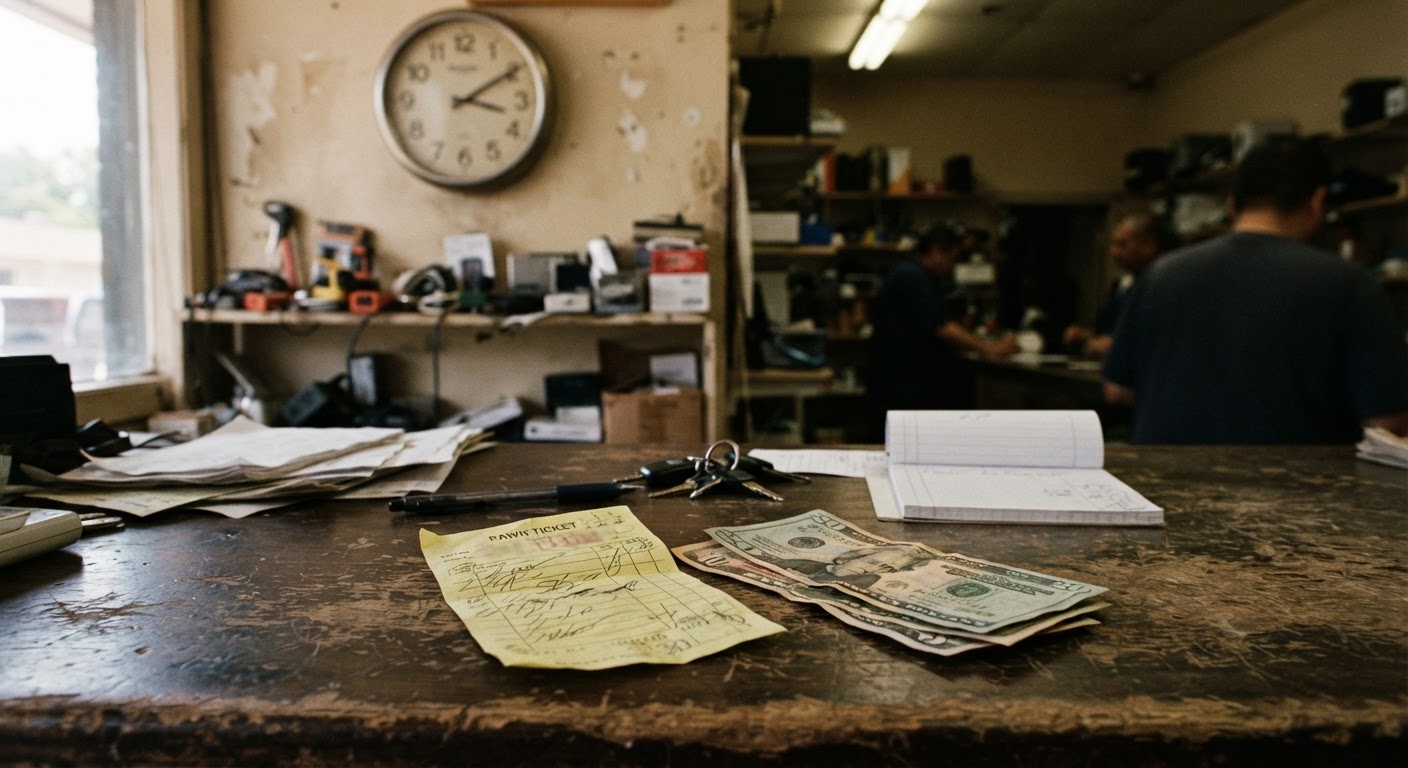
A pawn ticket looks simple, but it’s a different legal instrument than the payday loan or title loan paperwork you might be more familiar with. When you pawn something, you’re not really borrowing against your income or a car title — you’re handing over an item as collateral in exchange for cash, and the shop is holding onto it as security. There’s no credit check, no bank account debited automatically, and usually no collection calls if you miss a payment. Instead, the consequence is built into the object itself: if you don’t repay what you borrowed plus interest by a set date, the shop keeps the item and can sell it.
This matters because it changes what “default” actually means. With a payday loan, missing a payment can trigger overdraft fees, collection agencies, or damage to your credit. With a pawn loan, missing the deadline usually just means you lose the item — your credit typically isn’t touched, and you won’t get a collections call demanding the difference. That’s the tradeoff: pawn loans are lower-risk to your credit and finances overall, but the object you handed over has a real, ticking expiration date on it.
The redemption period explained: how many days state law typically allows before forfeiture
Every pawn transaction has a redemption period — the window during which you can pay back the loan plus interest and get your item back. This period is set by state law, and it typically runs somewhere between 30 and 120 days from the date you pawned the item, though the exact number varies significantly depending on where you live and sometimes on what type of item was pawned.
Your pawn ticket will state the exact redemption date. This is the single most important piece of paper in this situation — if you’ve misplaced it, call the shop and ask them to read the date to you over the phone, or stop in with ID. Don’t guess. Many people assume they have longer than they do because they’re thinking of a different state’s rules or confusing the pawn loan with a different kind of transaction.
Grace periods, extensions, and partial payments some pawnbrokers will accept
Even after the stated redemption date passes, many shops offer a grace period before the item actually goes up for sale. This isn’t guaranteed by law everywhere, but it’s common practice because pawnbrokers generally would rather get their loan repaid with interest than deal with reselling merchandise. A grace period might be a matter of days or a couple of weeks.
Some shops will also accept a partial payment to extend the loan — essentially paying just the accrued interest to “renew” the ticket for another full term without paying down the principal. This isn’t universal, and it’s entirely at the shop’s discretion in many places, but it’s worth asking about directly rather than assuming it isn’t an option. The worst outcome from asking is a “no.”
What happens the moment your item becomes eligible for resale or auction
Once the redemption period and any grace period expire, the item legally becomes the property of the pawnshop. At that point, it’s typically moved to the sales floor, listed online, or in some cases sent to auction depending on the shop’s practices and local rules. There’s no formal notice most places are required to send you beyond what’s already printed on your ticket — the deadline was disclosed upfront, so the shop generally isn’t obligated to call or write to warn you again.
This is also the moment where speed matters most. Once an item is sold to a third party, it is gone — there is no legal path to get it back from a buyer who purchased it in good faith. Everything you can still do has to happen before that sale occurs.
Can you still get it back after the deadline? What ‘unredeemed merchandise’ really means
“Unredeemed merchandise” is the technical term for items that passed their redemption date without being paid off. Once an item falls into this category, ownership has transferred to the shop, and you no longer have a legal right to reclaim it just because you show up with cash. That said, in practice, many shops will still let you buy it back if it hasn’t sold yet, sometimes for the original loan payoff amount, sometimes for a new price close to the sale value.
The key point is that this is entirely up to the shop’s willingness once the deadline has passed — it’s not a right you can insist on, it’s a favor they may or may not extend. That’s exactly why calling before the item is sold, even after the technical deadline, is worth doing immediately rather than assuming it’s already too late.
Interest and storage fees that grow the longer you wait
Every day you don’t redeem the item, interest is accruing on the original loan amount, and depending on your state and the shop’s policies, storage or holding fees may be added on top. This means the payoff amount you owe today is likely higher than what you borrowed, and it will keep climbing the longer you wait. Ask the shop for the current payoff total in writing or over the phone before you assume you know the number — don’t rely on math based on the original loan amount alone.
This growing balance is also a good reason to act sooner rather than later even within the grace period. Waiting to see if you can scrape together the money doesn’t just risk the item being sold — it also means you’ll owe more if you do manage to redeem it later.
How to negotiate a payment plan directly with the shop before the deadline hits
Pawnshops are usually small, locally run businesses, and the person behind the counter often has more flexibility than you’d expect. Before your deadline arrives, call or visit and be direct: explain that you need a few more days or weeks, and ask what your options are. Some possibilities to ask about specifically:
Paying just the interest to renew the loan term. Splitting the payoff into two smaller payments across a short window. Asking whether they’ll hold the item an extra few days past the ticket date without extra penalty if you’re close to having the money. None of these are guaranteed, but pawnbrokers generally prefer getting paid over having to process and resell merchandise, so there’s often more room to negotiate than people assume.
Alternatives if the item is already gone: how to avoid pawning again under pressure
If the item has already been sold, there’s unfortunately no way to reverse that. At this point, it’s worth stepping back from the pawn shop entirely and looking at other options for the cash need that sent you there in the first place — local emergency assistance funds, community action agencies, charitable programs tied to your specific bill (rent, utility, medical), or a short conversation with the biller about a payment plan before pawning something else.
Pawning under pressure tends to create a repeating cycle: you get cash fast, the deadline arrives faster than expected, and you’re back looking for another item to pawn to cover the gap. If you’re facing a shutoff, eviction notice, or overdue bill again, look for programs built specifically for that kind of emergency before reaching for another item to hand over the counter. Those resources exist precisely so you don’t have to keep trading possessions for time.